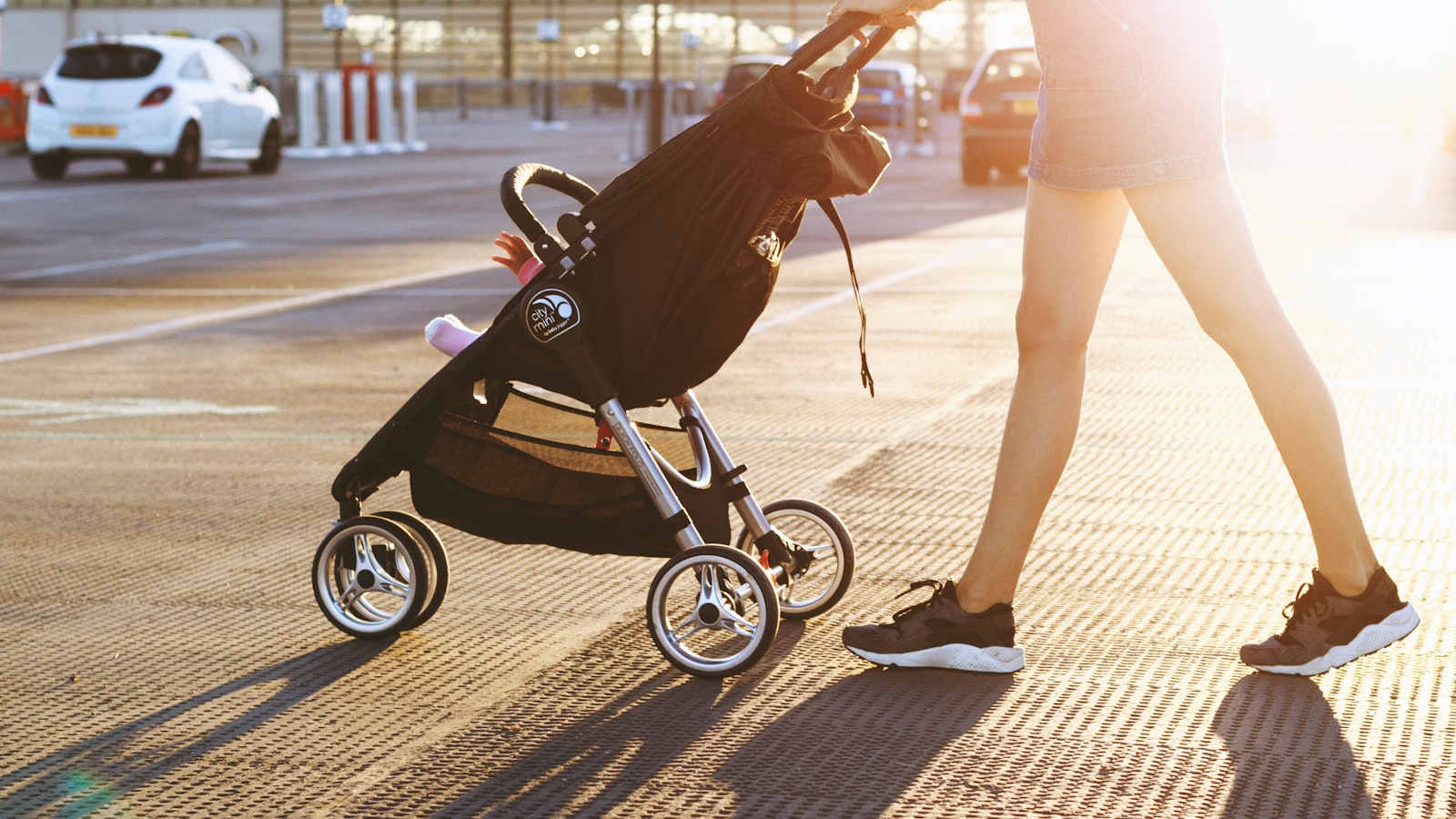
A stroller safe for a sitting eight-month-old can be unsafe for a newborn in the same model — because a newborn who can't hold their head up needs a near-flat recline, a bassinet, or a compatible car seat adapter 1. Beyond that, look for ASTM F833 compliance 2, brakes that hold on a slope, and never hang bags from the handles.
A stroller that's perfectly safe for a sitting, head-controlling eight-month-old can be genuinely unsafe for a newborn in the exact same model. The recline angle is the detail most buying guides skip entirely — here's what actually separates a stroller that's ready for day one from one that isn't yet.
The newborn recline problem
A newborn can't hold their own head up, so if the stroller seat can't recline almost flat, an upright or lightly-reclined position lets a baby's head slump forward and can compromise their airway. Some strollers handle this with a seat that genuinely reclines flat; others need a bassinet attachment, an infant insert, or a compatible car-seat adapter to be newborn-safe at all — and the rule is to use exactly what the manufacturer specifies for that model, not to improvise with rolled towels or extra padding.
If using a stroller from birth means guessing about the recline, improvising padding, or hoping a short walk will "probably be fine," that's the signal to stop and check whether this stroller is actually rated for newborn use in the first place.
The car seat on the stroller is for travelling, not sleeping
Clicking an infant car seat onto a stroller frame is convenient and entirely legitimate for getting from car to shop. What it is not is a sleep surface. A car seat holds a baby semi-reclined with the head supported from behind, and a young baby's head can slump forward into a position that restricts the airway — which is exactly why safe sleep guidance says to move a sleeping baby to a firm flat surface when you can.
The practical rule: use it for the journey, and transfer your baby once you're home or somewhere you can.
ASTM F833 and the Baby Safety Alliance verification seal
ASTM F833 is the governing US safety standard for strollers and carriages, covering braking, stability, restraint systems, latching and folding mechanisms, and openings that could create an entrapment hazard 2. The Baby Safety Alliance — the organization long known as JPMA before its 2025 rebrand — runs the third-party verification program built on that standard: more than 3,200 products a year, across 30-plus categories, retested annually rather than certified once and forgotten 1. A verification seal means an independent lab checked the specific model, not just that the brand claims compliance.
Harness, brakes, and frame stability
A five-point harness that actually adjusts down small enough to fit a newborn snugly, not just a bigger toddler.
Parking brakes that engage predictably and hold on a slope — test this in the store, not for the first time on a hill.
A frame that stays stable when the seat is loaded and the basket underneath is full, since tip-overs are usually a stability failure, not a harness failure.
Never hang bags from the handlebar. It is the single most common way strollers tip over, and it happens fastest at exactly the wrong moment — when you lift the baby out and the counterweight disappears. Everything heavy goes in the basket underneath, which is also where the manufacturer's weight limit applies. That limit is real; exceeding it changes how the frame behaves.
The mechanisms that cause injuries
Stroller injuries cluster around a few specific mechanisms, and knowing them makes the checks obvious:
Folding and hinges. Fingers get caught in folding joints. Fold and unfold with your child well clear, every time, and check the latch has fully engaged before putting them in.
Brakes on a slope. Never leave a stroller unattended on any incline, brakes or not.
Harness not used. Most falls from strollers involve an unbuckled child. Buckle every time, including for short trips.
Entrapment through leg openings. In a reclined or bassinet position, a baby can slide down. Use the crotch strap and follow the recline limits for the age.
Recalled models still in circulation. Strollers are recalled comparatively often, and hand-me-downs are how recalled ones stay in use — check the model against the CPSC database before accepting one 3.
Escalators. Never take a stroller on an escalator. Use the lift.
Jogging strollers have a separate age rule
A jogging stroller is not just a stroller with bigger wheels. Running transmits repeated jolts to a baby's head and neck, and infants don't have the head control to absorb them.
The general guidance is to wait until around six months, when a baby has solid head and neck control, before running with them — and to check your specific model's stated minimum, which is often higher. A jogging stroller may be fine for walking earlier with the right infant insert, but running is the part that waits.
Still reading? You might want the next one in your inbox.
New guides go out the moment they're published — no noise in between.
Also: use the wrist strap. A fixed front wheel is safer at speed, and a swivel wheel should be locked when running.
Matching the stroller to your actual life
Past the safety baseline, the differences that actually affect daily life are practical, not technical: whether it folds one-handed while you're holding a baby, whether it fits in your trunk or your apartment's entryway, and whether the wheels are built for sidewalks or genuinely handle gravel and grass. None of that shows up on a safety label, but it's usually what determines whether a stroller gets used every day or ends up folded in a closet after a month.
Things worth measuring before you buy rather than after:
Your trunk, folded dimensions, and whether you can lift that weight repeatedly
Your front door and hallway width, and whether you have stairs to a building entrance
Your usual surfaces — city pavements, gravel paths, grass, snow
Whether it fits your car seat, if you want a travel system, using the manufacturer's compatibility list rather than a generic adapter
Never cover a stroller with a blanket to create shade or block sun. A draped blanket traps heat and can raise the temperature inside significantly with almost no airflow, which is dangerous in warm weather. Use the built-in canopy or a purpose-made UPF cover that allows air through, and check your baby's chest or neck rather than judging by how the day feels to you.
Seek medical assessment after any fall from a stroller or a tip-over involving a head impact in an infant, even if your baby seems fine — go to an emergency department for vomiting, unusual drowsiness, a bulging soft spot, or any loss of consciousness. Seek urgent care for a finger injury from a folding mechanism, and for signs of overheating: hot skin, rapid breathing, unusual sleepiness or reduced wet diapers. If your baby seems to slump or their breathing sounds different in the stroller, take them out and reassess the recline before continuing.
FAQ
Can I use any stroller from birth?
No. A newborn needs a near-flat recline, a bassinet attachment, or a compatible car seat adapter. Check what your specific model is rated for 1.
Can my baby nap in the car seat on the stroller frame?
For a journey, yes. Move them to a firm flat surface once you can — car seats aren't designed for unsupervised sleep.
When can I run with a jogging stroller?
Generally not before about six months, once head and neck control is solid — and check your model's stated minimum, which may be later.
Why can't I hang my bag on the handles?
It's the most common cause of tip-overs, and the risk peaks exactly when you lift your baby out. Use the basket.
What does the Baby Safety Alliance seal mean?
An independent lab verified that specific model against the relevant ASTM standard, and retests annually 1.
Is it okay to put a blanket over the stroller for shade?
No — it traps heat with little airflow. Use the canopy or a breathable UPF cover.
Check the newborn recline before anything else, and use only the insert or adapter the manufacturer specifies. Look for ASTM F833 verification, test the brakes on a slope, buckle every time, and put everything heavy in the basket rather than on the handles. Wait until around six months to run, and never drape a blanket over the stroller for shade.
Sources
Every claim, sourced
3 sources cited in this guide
- 1JPMA is now the Baby Safety Alliance — Baby Safety Alliance, 2025Industry certification body · Accessed September 2026
- 2F833-21 Standard Consumer Safety Performance Specification for Carriages and Strollers — ASTM International, 2021Consensus safety standard · Accessed September 2026
- 3