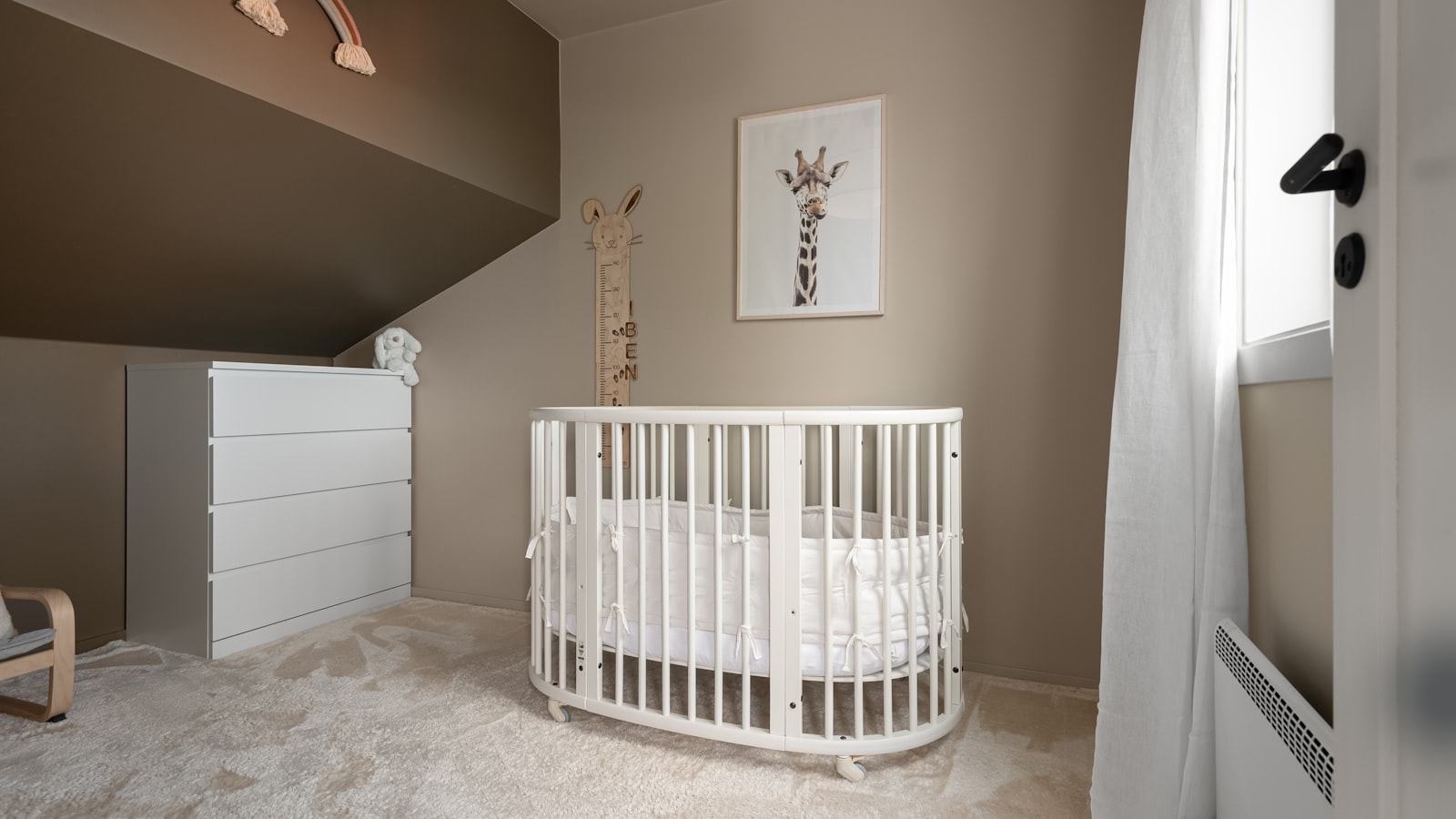
Three checks settle almost everything: slats no more than 2⅜ inches apart (a soda can shouldn't pass through) 2, no more than two fingers of gap between mattress and crib frame, and a mattress firm enough that your palm leaves no impression. A stricter federal crib mattress firmness standard took effect 3 May 2026 1.
A crib only has one job, but it fails that job in a specific, well-documented way: entrapment and suffocation from spacing and softness a parent can't judge just by looking. A federal rule that took effect in 2026 finally raised the bar on one of those — here's exactly what to check, including a ten-second test you can do with your own hand.
What changed in 2026
The Consumer Product Safety Commission's updated mandatory standard for crib mattresses took effect on May 3, 2026, incorporating a stricter 2025 version of the voluntary ASTM firmness standard 1. The update specifically targets excessively soft mattresses — the kind that can let a baby's face sink in far enough to compromise breathing, even when nothing else about the crib is wrong.
The practical implication is about stock rather than shopping. A mattress manufactured before that date may still be perfectly compliant with the previous standard and still on shelves, and second-hand mattresses certainly predate it. The hand test below is what closes the gap.
Slat spacing — the rule that hasn't changed, and shouldn't be skipped
Crib slats can't be more than 2⅜ inches apart — about the width of a soda can. Any wider and an infant's body can slip through while their head can't, which is the entrapment mechanism the spacing rule exists to prevent 2. This has been federal law since the sweeping 2011 crib standards overhaul, not something new — it's just still the single easiest thing to actually measure before buying.
Carry a soda can when looking at second-hand cribs. If it passes between the slats, walk away.
Mattress size and the two-finger gap test
A standard full-size crib mattress has to be at least 27¼ inches wide and 51⅝ inches long, and no more than 6 inches thick. The test that matters more than any of those numbers, though, is simple: try to fit two fingers between the mattress and the crib frame, at the side and at the end. If more than two fingers fit, the mattress is too small for that crib — a gap a baby can wedge into is a real suffocation risk, regardless of how firm or expensive the mattress itself is.
This is why "crib mattresses are a standard size" is only mostly true, and why buying the mattress and crib together is the low-risk approach.
Firmness — the test you can actually do yourself
Press down hard in the center of the mattress with your palm, then along the edges and in the corners. A compliant mattress springs back immediately and shouldn't hold your handprint. A useful comparison from safety educators: a safe mattress should feel like pressing your palm against it, not like pressing the back of your hand into something soft.
The instinct that a firm mattress must be uncomfortable is the thing to override here. It feels wrong to adult hands and it is correct for infants — soft is what adults like and what suffocates babies.
The rest of the checklist
Check | What good looks like |
|---|---|
Slat spacing | No more than 2⅜ in — a soda can won't fit through 2 |
Mattress gap | Two fingers or fewer, at sides and ends |
Firmness | Springs back instantly, holds no handprint |
Mattress thickness | No more than 6 inches |
Corner posts | Flush with the panels, or very tall — nothing in between to catch clothing |
Cutouts | No decorative cutouts in headboard or footboard |
Hardware | All present, tight, no sharp edges; re-tighten periodically |
Mattress height | Lowest setting once your baby can pull to stand |
Mattress height is the one that changes over time rather than at purchase. Drop it before your baby can pull up, not after — falls from a crib set too high are a common and entirely avoidable injury.
Bassinets, play yards and travel cots
The same principles apply with different specifics: a firm, flat surface, a tight-fitting sheet made for that product, and nothing else inside.
Still reading? You might want the next one in your inbox.
New guides go out the moment they're published — no noise in between.
Two frequent errors. First, never add a mattress or padding to a play yard — the thin mat that came with it is the safe surface, and adding softness is how a compliant product becomes unsafe. Second, bassinets have weight and developmental limits — typically ending when a baby can push up on hands and knees or roll — and those limits matter more than whether your baby still fits.
Second-hand travel cots frequently arrive without their original mat. Without it, the product is incomplete; don't substitute.
A firm mattress doesn't make loose bedding safe. Bumpers, pillows, blankets, and stuffed animals are still a suffocation risk in an otherwise fully compliant crib — the safe-sleep guidance is the same regardless of how good the mattress is. Mesh "breathable" bumpers are still bumpers, and the recommendation is nothing in the crib but a fitted sheet 3.
What to avoid entirely
Drop-side cribs — banned from manufacture and sale since June 28, 2011, after being linked to at least 32 infant suffocation and strangulation deaths since 2000 2.
Any secondhand crib made before June 2011, since it predates the current federal standard entirely.
Cracked, splintered, or missing slats and hardware, even on an otherwise compliant crib — damage voids the safety margin the standard was built around.
Crib bumpers of any kind, including mesh.
Sleep positioners, wedges and inclined attachments.
A crib with a missing manual and unknown model, where you can't confirm what it is or check for a recall.
Where to put it
Placement matters as much as the crib itself. Keep it away from windows, and specifically away from blind and curtain cords, which are a strangulation hazard. Keep it clear of radiators, heaters and direct sun, and away from any furniture a child could use to climb out. Once your baby can stand, check that nothing reachable — a mobile, a wall hanging, a monitor cord — is within arm's reach of the crib.
Call emergency services for any entrapment or suffocation event, or if you find your baby unresponsive, limp, or blue. After any fall from a crib, seek medical advice for an infant even if they seem fine, and go to an emergency department for vomiting, unusual sleepiness, a bulging soft spot, or any loss of consciousness. If you discover your crib or mattress is subject to a recall, stop using it immediately rather than waiting for a replacement part to arrive.
FAQ
How do I check slat spacing quickly?
A standard soda can is about 2⅗ inches across. If it passes between the slats, they're too far apart 2.
My mattress leaves a small gap at the end. Is that okay?
Two fingers or fewer is the limit. More than that and the mattress is too small for that crib — replace it.
Are mesh breathable bumpers safe?
The guidance is nothing in the crib but a fitted sheet. Breathable bumpers are still bumpers.
Can I use my older child's crib?
Only if it was made after June 2011, is complete and undamaged, and isn't recalled. Anything older predates the current standard 2.
How firm is firm enough?
Press hard with your palm — it should spring straight back and hold no impression. If it feels comfortable to you, it's probably too soft.
When should I lower the mattress?
Before your baby can pull to stand, not after. Go to the lowest setting at that point.
Soda can between the slats, two fingers around the mattress, palm print that doesn't stay. Nothing else in the crib — no bumpers, no positioners, no extra padding in a play yard. Avoid anything made before June 2011, drop the mattress before your baby can pull up, and keep the crib well away from window cords.
Sources
Every claim, sourced
3 sources cited in this guide
- 1Safety Standard for Crib Mattresses — Consumer Product Safety Commission (Federal Register), 2026Federal regulation · Accessed September 2026
- 2New Crib Standards: What Parents Need to Know — American Academy of Pediatrics (HealthyChildren.org)Clinical guidance · Accessed September 2026
- 3