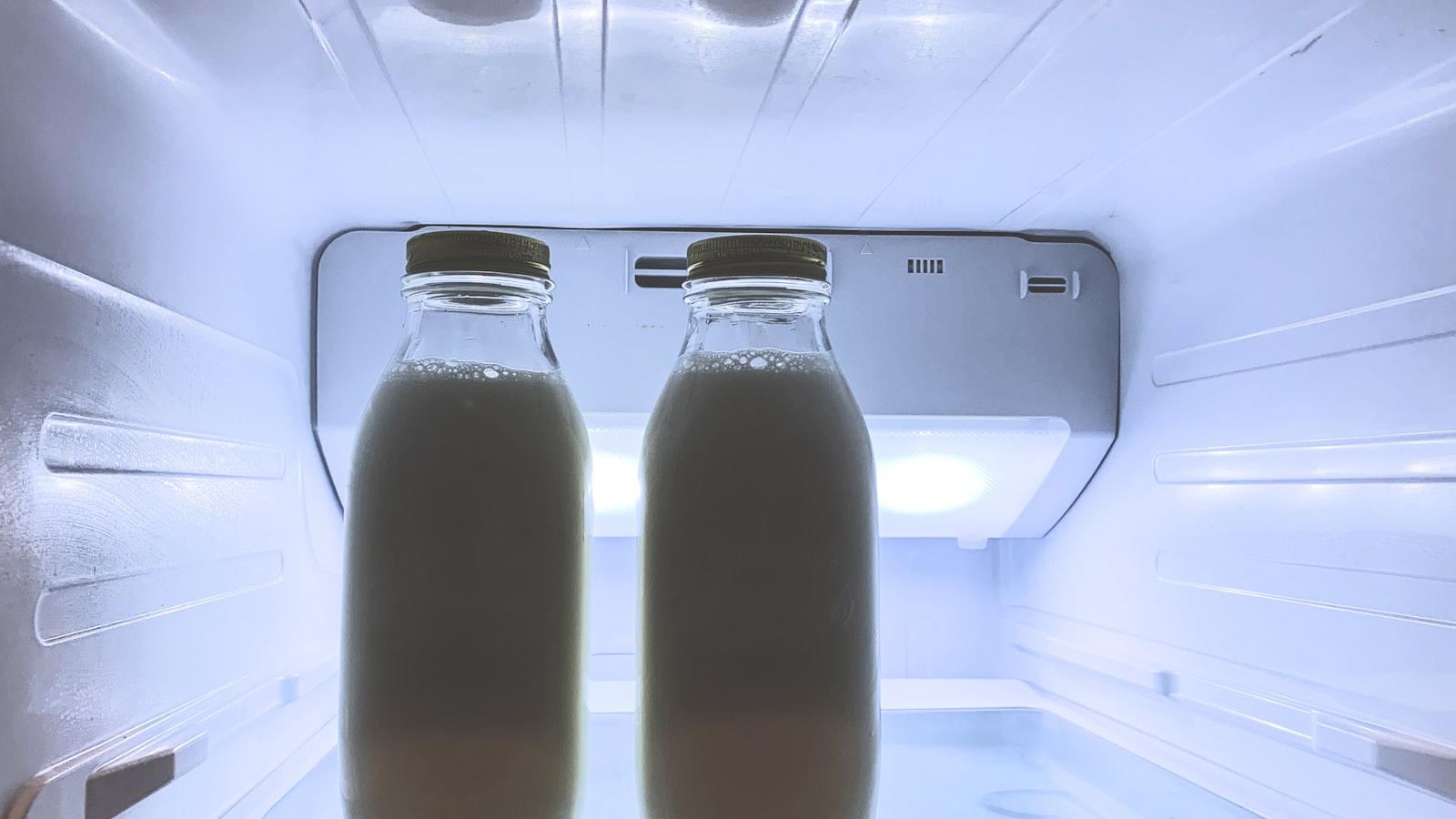
Fresh breast milk keeps about 4 hours at room temperature, 4 days in the fridge, and up to 12 months in the freezer — though within 6 months is best 1. Once milk has fully thawed it gets a much shorter window and cannot be refrozen. Leftover milk in a bottle your baby drank from must be used within 2 hours of the feed ending, then discarded 1.
Breast milk storage rules get repeated so often that they start to blur together, but the CDC's actual guidelines are specific, and the details matter — particularly the fact that thawed milk can never be refrozen, which is the mistake that wastes the most milk.
Storage times at a glance
Milk | Room temperature (up to 77°F / 25°C) | Refrigerator (40°F / 4°C) | Freezer (0°F / -18°C) |
|---|---|---|---|
Freshly pumped | Up to 4 hours | Up to 4 days | 6 months best, 12 months acceptable |
Thawed (previously frozen) | 1–2 hours | Up to 24 hours | Never refreeze |
Leftover from a bottle baby drank from | 2 hours after the feed ends | Do not return to fridge | Do not freeze |
These are "use by" limits rather than targets. If milk will not be used within a few hours, the CDC's advice is simply to refrigerate it rather than let it ride out the countertop window — and that goes double in a warm room 1.
Once it's thawed, the clock changes
Previously frozen milk that's been thawed can be kept at room temperature for 1–2 hours, or in the refrigerator for up to 24 hours — but it should never be refrozen once fully thawed, and it shouldn't go back in the fridge after your baby has started drinking from it. If your baby doesn't finish a bottle, use the leftover milk within 2 hours of the feeding ending, then discard the rest 1.
There is one genuine exception worth knowing, because it saves milk that people throw away unnecessarily. Milk that has *started* to thaw but still contains ice crystals can be refrozen 1. The rule that matters is about fully thawed milk. If you pulled a bag from the freezer, changed your mind twenty minutes later, and it's still visibly icy, it can go back.
How to actually store it
Use breast milk storage bags or clean, food-grade containers with tight-fitting lids — glass or BPA-free plastic
Label every container with the date pumped, and use the oldest milk first
Leave about an inch of space at the top of containers before freezing, since milk expands as it freezes
Store milk toward the back of the freezer or fridge, not in the door, where temperature fluctuates more with each opening
Do not store breast milk in disposable bottle liners or generic plastic bags not designed for milk storage
On combining sessions: cool freshly pumped milk before adding it to already-refrigerated or frozen milk, rather than pouring warm milk straight in. Adding warm milk rewarms the older portion, which restarts its clock in the wrong direction 1. The stored batch always takes the date of the *oldest* milk in it.
Cleaning pump parts is a safety step, not housekeeping
This is the part most storage guides skip, and it is the part with the most serious consequences. Pump parts that touch milk can grow bacteria, and the CDC is direct that infants have become ill from contaminated milk caused by pump parts that weren't cleaned properly 3.
Rinse parts that touch milk under running water as soon as possible after pumping, then wash with soap and warm water, or run dishwasher-safe parts through the dishwasher 3.
Sanitize at least once a day if your baby is under 2 months old, was born prematurely, or has a weakened immune system. For older, healthy babies, careful cleaning after every use may be enough without daily sanitizing 3.
Air-dry parts completely on a clean paper towel or unused dish towel — don't rub them dry, which can transfer germs — and store them somewhere clean and protected once dry, such as a sealable food storage bag 3.
If you use a wash basin or bottle brush, rinse it well and let it air-dry after each use, and clean it every few days 3.
Cronobacter, the bacterium most associated with powdered infant formula, has also been traced to contaminated breast pump equipment in documented infant infections. It can cause sepsis and meningitis in young infants 4. This is precisely why the "sanitize daily under 2 months" rule exists — it is not excessive caution, and it applies to pumped breast milk as well as to formula.
Thawing safely
Thaw frozen milk in the refrigerator overnight, or hold it under cool then gradually warmer running water. Never microwave breast milk — it heats unevenly and can create scalding hot spots, and it can also break down some of the milk's beneficial properties. A separated or layered look after thawing is completely normal; just swirl gently to recombine, don't shake vigorously.
Milk does not need to be warmed at all. Plenty of babies take it cool or at room temperature, and if yours will, you have removed an entire step from every night feed.
How often to pump
If you are pumping instead of feeding at the breast, the general principle is to match what your baby would be doing — for a newborn, that means roughly 8 to 12 sessions in 24 hours, including at least one overnight, because milk production responds to how often milk is removed rather than to the clock 2.
If you are pumping alongside direct feeding — a bottle for daycare, a stash for someone else to give — you have much more latitude, and the common approach is one extra session at whichever time of day you reliably have the most milk. For most people that is the morning.
Two practical notes that save a lot of frustration. Output is not a measure of supply: what a pump extracts and what a baby extracts are different, and a baby who is gaining well is getting more than a pump suggests. And flange fit matters more than most people expect — a flange that is too large or too small is a common and fixable cause of poor output and sore nipples, and pump manufacturers publish sizing guides.
Still reading? You might want the next one in your inbox.
New guides go out the moment they're published — no noise in between.
Your right to pump at work
Many parents don't know this exists, so it is worth stating plainly: in the United States, most nursing employees have a federal right to pump at work.
The PUMP for Nursing Mothers Act, which became law on 29 December 2022, extended these protections to millions of workers who had previously been excluded — including agricultural workers, nurses, teachers, truck and taxi drivers, home care workers, and managers 5.
Employers must provide reasonable break time to express milk, each time you need to, for one year after your child's birth 5.
They must provide a space that is shielded from view and free from intrusion from coworkers and the public 5.
A bathroom does not count, even a private one. The law is explicit on this point 5.
Break time for pumping does not have to be paid under federal law — but if your employer already provides paid breaks and you use that time to pump, you must be paid the same way as anyone else using that break 6.
Coverage for rail and motorcoach workers began 29 December 2025, and there are narrow exemptions where compliance would cause significant expense or unsafe conditions 5. State laws sometimes provide more than the federal floor, never less.
Getting milk to daycare
Milk travels well in an insulated cooler bag with frozen ice packs for up to 24 hours 1. Label every bottle or bag with your baby's name and the date pumped — most licensed providers require both, and unlabeled milk usually gets sent home unused.
Ask your provider two things before the first day: whether they want milk sent frozen or refrigerated, and what they do with a bottle your baby doesn't finish. Their answer is usually set by licensing rules rather than preference, and knowing it in advance stops you from sending milk in a form they can't accept.
Call your doctor or a lactation consultant if pumping is persistently painful, if you see cracked or bleeding nipples, or if you develop a hard, red, wedge-shaped area on the breast along with fever, chills or body aches — that combination can indicate mastitis and usually needs prompt treatment. A sudden unexplained drop in output is also worth a conversation rather than a wait-and-see.
FAQ
Can I add freshly pumped milk to a bottle already in the fridge?
Yes, but cool the fresh milk first rather than adding it warm, and date the combined container with the older milk's date 1.
My thawed milk smells soapy or metallic. Is it spoiled?
Usually not. Some people's milk has higher lipase activity, which changes the smell and taste after storage without making it unsafe. Many babies take it anyway; if yours refuses, that is the usual reason.
Do I have to sanitize pump parts every single time?
Wash after every use, always. Daily sanitizing is specifically recommended for babies under 2 months, preemies, and immunocompromised infants; for older healthy babies, thorough washing after each use may be sufficient 3.
Can I leave pump parts in the fridge between sessions instead of washing?
The CDC's guidance is to clean parts after every use. The fridge-hack is widely shared online but is not what the safety guidance says, and the documented pump-related infections are the reason to take that seriously 3.
How much milk should I be getting per session?
There is no target you should measure yourself against. Output varies enormously by person, time of day, and pump, and it does not reliably reflect how much milk your baby gets at the breast.
Does my employer have to pay me for pumping breaks?
Not under federal law, unless you are using an existing paid break — in which case you must be paid as any other employee would be for that break 6.
Four hours out, four days in the fridge, six months in the freezer for best quality. Cool milk before combining it, never refreeze fully thawed milk, and wash pump parts after every use — sanitizing daily if your baby is under 2 months. And if you are going back to work, you have a federal right to break time and a private space that is not a bathroom.
Sources
Every claim, sourced
6 sources cited in this guide
- 1Breastfeeding FAQs: Storing and Preparing Breast Milk — Centers for Disease Control and PreventionPublic health guidance · Accessed September 2026
- 2Pumping Breast Milk — Centers for Disease Control and PreventionPublic health guidance · Accessed September 2026
- 3How to Clean and Sanitize Breast Pumps — Centers for Disease Control and PreventionPublic health guidance · Accessed September 2026
- 4Cronobacter sakazakii — U.S. Food and Drug AdministrationFood safety guidance · Accessed September 2026
- 5FLSA Protections to Pump at Work — U.S. Department of Labor, Wage and Hour DivisionFederal law · Accessed September 2026
- 6Fact Sheet #73: Break Time for Nursing Mothers under the FLSA — U.S. Department of Labor, Wage and Hour DivisionFederal law · Accessed September 2026